Halebidu Heritage trip Part -(2)
 A just few
steps away from the Kedaresvara temple is Basadi compound south of
Basadihalli, located close to the Hoysaleswara Temple where there are
of Adinatheswvara, Shantishvara and Parshvanatheshvara Jain Basadis
with agleam black stone pillars is considered as a part of the group
of the Jain cloisters is considered as the most important Jain
temple. Hardly a stone’s throw away but cut off from the tourist
circuit is the nonchalant hamlet of Basadihalli with three Jinalayas
dating to the period of King Vishnuvardhan who was earlier a Jain
called Bittideva.
A just few
steps away from the Kedaresvara temple is Basadi compound south of
Basadihalli, located close to the Hoysaleswara Temple where there are
of Adinatheswvara, Shantishvara and Parshvanatheshvara Jain Basadis
with agleam black stone pillars is considered as a part of the group
of the Jain cloisters is considered as the most important Jain
temple. Hardly a stone’s throw away but cut off from the tourist
circuit is the nonchalant hamlet of Basadihalli with three Jinalayas
dating to the period of King Vishnuvardhan who was earlier a Jain
called Bittideva.

.jpg)
.jpg)

.jpg)
.jpg)
.jpg)
.jpg)
.jpg)
.jpg)
.jpg)
.jpg)
.jpg)
.jpg)
.jpg)
.jpg)
.jpg)
.jpg)
.jpg)
.jpg)
.jpg)
 A just few
steps away from the Kedaresvara temple is Basadi compound south of
Basadihalli, located close to the Hoysaleswara Temple where there are
of Adinatheswvara, Shantishvara and Parshvanatheshvara Jain Basadis
with agleam black stone pillars is considered as a part of the group
of the Jain cloisters is considered as the most important Jain
temple. Hardly a stone’s throw away but cut off from the tourist
circuit is the nonchalant hamlet of Basadihalli with three Jinalayas
dating to the period of King Vishnuvardhan who was earlier a Jain
called Bittideva.
A just few
steps away from the Kedaresvara temple is Basadi compound south of
Basadihalli, located close to the Hoysaleswara Temple where there are
of Adinatheswvara, Shantishvara and Parshvanatheshvara Jain Basadis
with agleam black stone pillars is considered as a part of the group
of the Jain cloisters is considered as the most important Jain
temple. Hardly a stone’s throw away but cut off from the tourist
circuit is the nonchalant hamlet of Basadihalli with three Jinalayas
dating to the period of King Vishnuvardhan who was earlier a Jain
called Bittideva.
Halebid is
said to have originally contained no less that 720 Jain Bastis but
now there are only three of them remains. This Jain temples at
Halebid of which are believed to have been built during the reign of
Hoysala period, was built around ShantalaDevi reign. Though
Vishnuvardana converted to Hinduism at the instance of Sri
Ramanujacharya he & his queen patronised Jain faith too, his wife
Shantala remained a Jain and built Jaina temples.
.jpg)
The
Parsvanathesvara Basti is the Largest of these Bastis containing an
image of Parshvanatheshvara which is a piece of beautiful
workmanship. Among these three shrines, Parswanathaswamy Temple is
the most noteworthy the twelve pillars that hold the doom appear
thoroughly polished and have been shaped attractively. These pillars
have been made in a very fine and very attractive manner. All the
pillars consist of some beautiful images. The lathing of these
pillars has been done very well and all the images are very different
from each another. The shine on these mirrors allows the visitors to
see their faces very clearly.
.jpg)

.jpg)
This Basadi
looks simple at the outside, but possesses very rich decorations
inside. The sculpture of the underside sealing, called Bhuvaneshwari,
is very attractive. The round pillars of nice resplendent black stone
found in the Navaranga portion reflect the spectators images!.There
is a special place for such exquisite pillars in Hoysala
architecture. Lord Parshvanatheshvara figure fourteen feet in height
& with curly hairs is made out of black granite stone. On the
figurine, a seven-headed serpent has been imprinted appears to be
protecting the Lord. Another tall pillar with a sculpture of Brahma
stood outside one of them while the ancient well here was almost dry
.jpg)
.jpg)
.jpg)
The central
temple is of Lord Adinatheswvara while Shantishvara is located in the
east and both of these temples have their own importance in their
religion. Adinatha
Basadi was built by Devara
Heggade Malli Mayya. It is a little one containing proportionately a
little Navaranga and a little sanctuary. A Saraswatee idol exists in
the Deva Koshtha of the Navaranga. Since the original idol of the
sanctuary is broken, it has been deposited in the neighboring
Saantinatha Basadi.
.jpg)
Saantinatha
Basadi
is a high and broad Basadi situated on the
right of the Adinatha Basadi. One going by the name Madhukanna
Vijayanna built this beautiful jinalaya in 1256 AD with the
substantial encouragement offered by the association of the
businessmen of Dhorasamudra. The outer wall of this Basadi is
ofcourse very simple. No embellishments there with decorations and
idols. But here too, in the Navaranga portion, there are huge shining
round pillars taking their appropriate positions. A monolithic 15ft
idol of Santhi natha satnds in sanctuary in the Sthanaka posture.
Once in 12 years the Head Bathing Festival (Mahamasthakabhisheka)
takes place here. Facilitating the bathing performance brick steps
have been built in a convenient way. In front of the Basadi entrance
there is a measuring column call Manastambha as lofty as 30ft.
.jpg)
.jpg)
The Archaeological Survey of India
board gave us some information dedicated to Parshwanatha, Shantinatha
and Adinatha, these Jinalayas were built in memory Boppadeva. The
big Basadi Facing the entrance of the Compound is called Vijaya
Parshwanatha Basadi. This was completed in memory of Ganga Raja. The
commander of Vishnuvardhana Raya 1113 AD, by his son Boppadeva.
Originally as a memoir of the title of Ganga Raja it had the
nomenclature styled as Dhrohagharatta Jinalaya. During the opening
ceremony of the Jinalaya, Vishnuvardhanaraya became Victorious in the
battle of Bankapura. So this was renamed as Vijaya Parswanatha
Jinalaya and was honored with royal donations for its maintenance.
.jpg)
.jpg)
.jpg)
Attached to the walls of the Navaranga
there are in all 24 Peethas (seats) indicating the east while
existence of the idols of 24 Teerthankaras there. They have all
vanished today. In-front of this Basadi there is a Mukha Mantapa
(Portico Hall) comprising many pillars, along with a big inscription
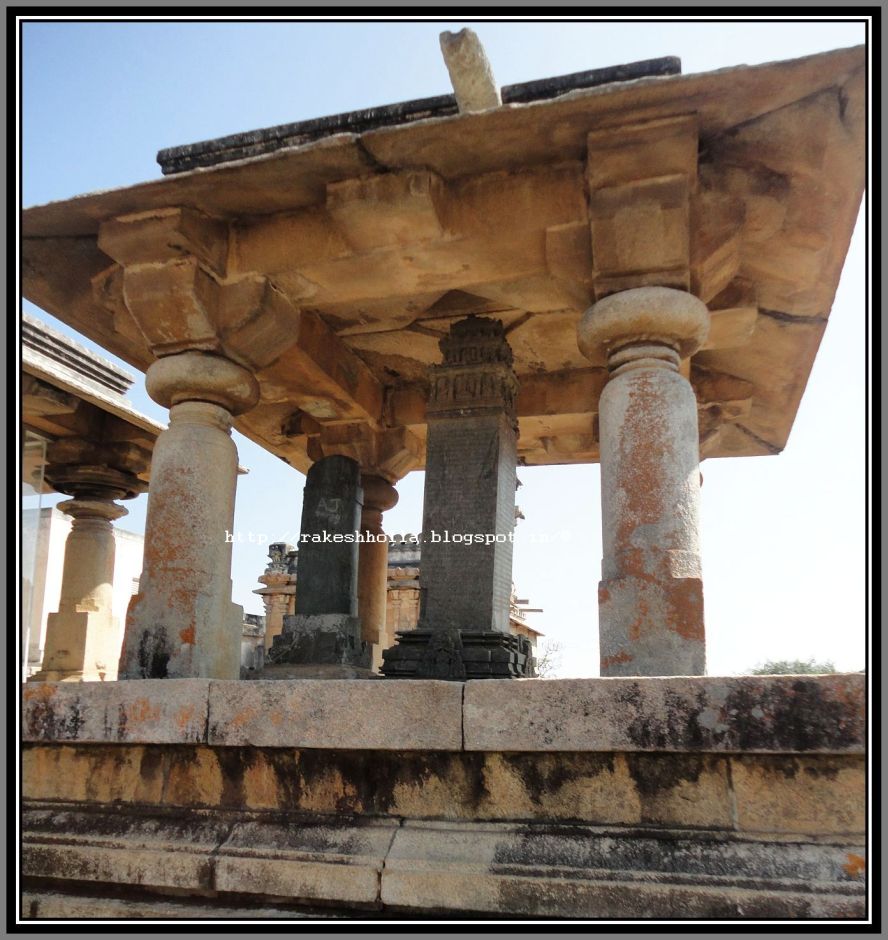
describing the construction of this Jinalaya.
.jpg)
.jpg)
.jpg)
.jpg)
.jpg)
.jpg)
All these
three Basadi's being comprehended with in one compound, have common
Pushkarnee on the north -east corner of the compound.These Jain
Temples are renowned for their decorated pillars which are highly
polished almost resembling mirrors. The construction of Basadi Halli
temple is of very high grade and consist of many appreciable carvings
that can be seen all over specially at the top of the doors.
.jpg)