Showing posts with label Vijayanagar. Show all posts

Saturday, October 17, 2015

Ranganatha Swamy Temple, Holalu

Ranganatha Swamy (Anantha Shayana) Temple situated at Holalu village, which is situated 32km from Hovina hadagali and 4km from Mailara. This temple is assignable to the middle of 12th century A.D. in the region of Vijayanagara. The temple facing East and it is Ekakuta temple. The Ranganatha is enshrined in the main sanctum hall, surrounded by Lord Ganapathi, Lord Brahma and Maha Lakshmi.
 Approximately 2 feet tall, 12 feet wide and 15 cm thick, the Ranganatha is carved from a single slab of dark green chlorite schist. Such fine grained soft metamorphic stones became the medium of choice of Karnataka’s artisans from the 11th to the 14th centuries, driving an aesthetic revolution in both sculpture and architecture.  
An elaborate ornamental archway springs from columns behind the attendants and encircles the principal figure. The fertility of the design the through finish the richness of ornamentation and the hard stone had turned out to be pieces of vax in the hands of craftsman of that bye gone era. The Ranganatha Swamy image is exceedingly handsome and the sculptor has reached his pinnacle here the perfectly carved is awe inspiring.
Beautiful idol of Lord Brahma
Recently the temple has renovated by the villagers. After seeing the wonderful temple of the Lord Ranganatha Swamy feeling blessed we started our return journey.

Thursday, May 7, 2015

Nagareshwar temple, Bankapur

Nagareshwar temple is located in the grounds of Bankapur's famous peacock sanctuary; one sees more peacocks painted on signboards than they are seen in the sanctuary. The temple base was about ten feet below the level of the ground. One had to climb down a few steps to see the temple fully.
Local refer this temple as Aravattu-kambada-gudi, meaning 60 pillared temple in Kannada, as the great hall of the temple is supposed to be supported on sixty columns. However, originally it had only fifty-two columns. Six columns were added by Muslims who converted it into a mosque. Another two are between this Mandapa and inner hall, so counting all it comes to sixty. The carvings on the pillars of Chalukyan period are rarely repetitive, some of the carvings that seemed to be unique.
 This large temple has a big mandapa which is open for entrance from three sides. This large mandapa is connected with a small hall or navaranga through a porch. Navaranga is also entered from three sides, east, south and north. Low parapet wall runs on all sides of the outer large mandapa. On this well are provided numerous mini-shirnes with Nagara tower. Above these shrines are miniature images often describing some story such as Vishnu’s Trivikrama episode. Inside the hall, runs a stone bench on all sides.
 Many of these miniature images are chiselled off by Muslim when the temple served as a mosque during the occupation of the Bijapur army. However, what remains depict the genius of the artists and their imagination. There are two beautiful arabesque windows, one on each side of the entrance of the inner hall. Both of these windows are damaged leaving only few jagged frames.
The doorway of the hall is also devoid of its various images during the Muslim rule.  I realized that the important face is the Kirttimukha’s (lion-face) with bulging eyes that appears everywhere. The word Kirttimukha means glorious face for various reasons which we won’t get into here. It is not an ordinary face of a lion, the faces usually portrayed with bulging eyes with two strands emerging from its mouth. In some interpretations this is the face of a monster swallowing its tail following Shiva's order so that it was finally left with its face.
One of the features of the temple at Bankapur is the markings on the floor of the temple which seems to have been formed by rubbing or by constant dripping of water from leaking roofs over long time. A cursory inspection of the roof shows little sign of recent leakage the local people insist that these are marks left by the Pandavas who spent their year of vanavas at Bankapur.
Though this is often said to be a Jain temple, however Henry Cousens differ with this opinion. And he seems to be correct as the inscriptions speak of donations to Shiva temple. Inscription speaks an Acharya Vimalashakti of Kalamukha lineage belonging to this temple; therefore this temple was dedicated to Shiva and was associated with Kalamukha sect. But there was a Jain temple for sure in Bankapura as inscription talks about it.
During the occupation of the Muslim king of Bijapur, this temple was converted into a mosque. However they later built another mosque inside the fort. To convert this temple for their usage, they squared off the back corners of the hall, which were originally recessed like the front. They then built up a wall upon the bench to meet the beams under the cornice, and finally inserted a Mihrab (prayer slab) within the doorway that led towards the shrine. In this process they chiseled away all the small images flaunted on the front parapet wall of the temple.
The destruction such destruction is there almost all over the temple and one has to go towards the back to find a few that has not been damaged fully so as to get an idea of how it could have been. The temple at Bankapur was evidently the "superb temple" that Adil Shah destroyed and replaced with a mosque when he took the city in 1575'. We have little idea of what this temple could have been. A Madhwa Brahmin's house has the presiding deity (Lord Narshimha) of Bankapur below the ground level to protect it from Muslim aggression during later part of the 18th century.
At the same time whatever the destruction that has taken place, the ordinary people of this country must remain one of the most creative craftsmen who can fashion images of god at will and almost in an instant. No matter how much one destroys they will come up again with the same cheer and song that come so naturally to them even if a fear of religion is thrust on them. 
If the monotheistic god of Islam or Jews brooks little tolerance for other gods, our infinite-theistic approach can brook intolerance and come out unperturbed absorbing al destruction and coming out in a new creation. That is what Bankapur teaches us. The secular snakes in could be the past and the future.
HISTORY- What is historically interesting about this for site is that it has had several levels of rulers who date back at least to the 5th century AD and to earlier times. The earliest known reference of Bankapur is found in a Kolhapur Jain manuscript, dated 898 CE, where it is mentioned that the great city of Bankapur was named after the Chellaketan chief Bankeyaras who was a feudatory of Rashtrakuta king Amoghavarsha I. The above might be true as it is evident from inscriptions that Rashtrakutas would have ruled over it.
Bankapur served as the capital of the Rashtrakuta king Indra-Vallabha as found in an inscription from Boganur in the Navalgund Taluk. Bankapur would have been an important town associated with Jainism. Inscriptions found here mention as Jain temple patronized by the ruling chiefs. Five different Jain schools were established at the town during that time as evident from inscription. Western Ganga kings are known for their patronage towards Jainism this all suggests that Bankapur was an important Jain centre during ninth-tenth century CE.
Bankapur was also famous as a Kalamukha center. Nagreshwar temple inscription talks about land grants given to a Kalamukha priest, Vimalashakti. Shakti in his name suggests that he might have belonged to the Shakti-parishad branch of Kalamukha sect. It is not strange to find Kalamukhas vestiges in Bankapur. Gadag and Haveri, both near Bankapur, were very important Kalamukha centres in the past. After the Rashtrakutas, Bankapur being situated under Panungal-500 (modern Hangal) came under the Hangal Kadamba chiefs. They ruled as the feudatory chiefs under the Western Chalukyas. After the fall of Western Chalukyas, it was ruled by Suenas and Hoysalas. After the Hoysalas, the town came under the Muslim rule before moving into the Vijayanagara kingdom.
 The third Bahmani king, Mujahid Shah (1375-78 CE), demanded Bankapur fort from the Vijayanagara king Bukka (1356-1377 CE), but the latter did not give up. In 1406, the eighth Bahmani king, Sultan Feroze Shah (1397-1422 CE), took over Bankapur from Vijayanagara king Deva Raya I (1406-1422 CE) getting about 60,000 Hindu prisoners. Deva Raya ceded for peace, giving his daughter in marriage and the Bankapur fort to the Sultan. Bankapur played a very important role in Krishna Deva Raya’s battle with Sultan of Bijapur. Krishna Deva had almost the entire south under his sway. He was anxious to secure horses for his troops. Bankapur was on the way from Goa to Vijayanagara.
In 1512 CE, Bankapur chief sent a congratulation message to Portuguese on Afonso de Albuquerque’s capture of Goa. He also asked for permission to import three-hundred horses a year. The request was granted. It was necessary for the Bankapur chief to be on cordial relationship with Portuguese so that horses can be obtained. This political settlement was very beneficial for Krishna Deva Raya.
In 1573, Ali Adil Shah of Bijapur moved against Dharwad and Bankapur. Bankapur, under his chief Velappa Ray, defended bravely the fort for one year and three months. But he had to surrender at last to Adil Shah as he did not get help from his masters. Firishtah mentions that Adil Shah destroyed a superb temple inside the fort and himself laid the first stone of a mosque which was built on temple’s foundation. In 1673, Abdul Karim Khan, of the line of the Savanur Nawabs, was appointed governor of the province of Bankapur under the patronage of Bijapur. In 1747, Nawab of Savanur made a treaty with the Marathas in which he gave up all his land keeping Bankapur, Hangal, Hubli to himself. In 1755, Savanur was besieged by French general Bussy. To save Savanur, the Nawab pledged the Bankapur fort to the Holkars. In 1776, Hyder Ali took over Bankapur and Savanur. In 1780, Tipu Sultan celebrated Muharram in Bankapur. In 1802, Bankapur was ceded to British by Peshwa. These were restored to him in 1803 in exchange of Bundelkhand.

Wednesday, September 12, 2012

Vindhyagiri (Indragiri) - A colossal Monolith Hill

Most exotic Jain Temples in India
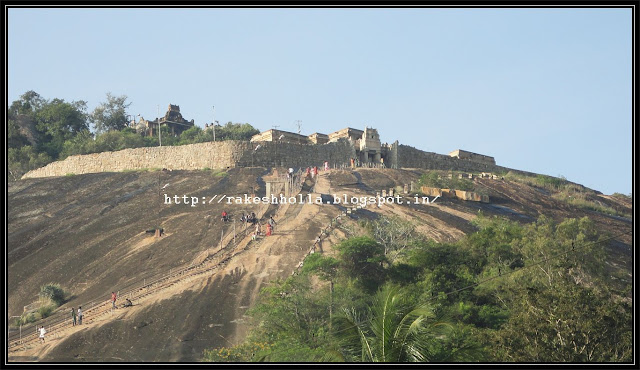
Shravanabelagola town is 10km from Chananrayanpatna, it has two hillocks, Indragiri and Chandragiri. The former one is also known as Vindhyagiri, and stands 143 meters high. About five hundred steps lead to the top of this picturesque hillock where 58.6 ft high Bahubali (Gomata) statue stands.

The Jain religion is contemporary of Buddhism, believes in cycle of rebirths and consequently regards life as painful, longing for liberation. It came to Karnataka four centuries before the Christian era. The Gangas, Kadambas, Chalukyas and Hoysala kings had encouraged the Jainism. They have left innumerable shrines, Basadis, Gomata statues and Stambhas. The Shravanbelagola is also one of the important Jain monuments of Karnataka. Shravanabelagola has been great seat of learning for thousands of years and is home to some of the most beautiful Jain fine arts.
Jain monuments in India
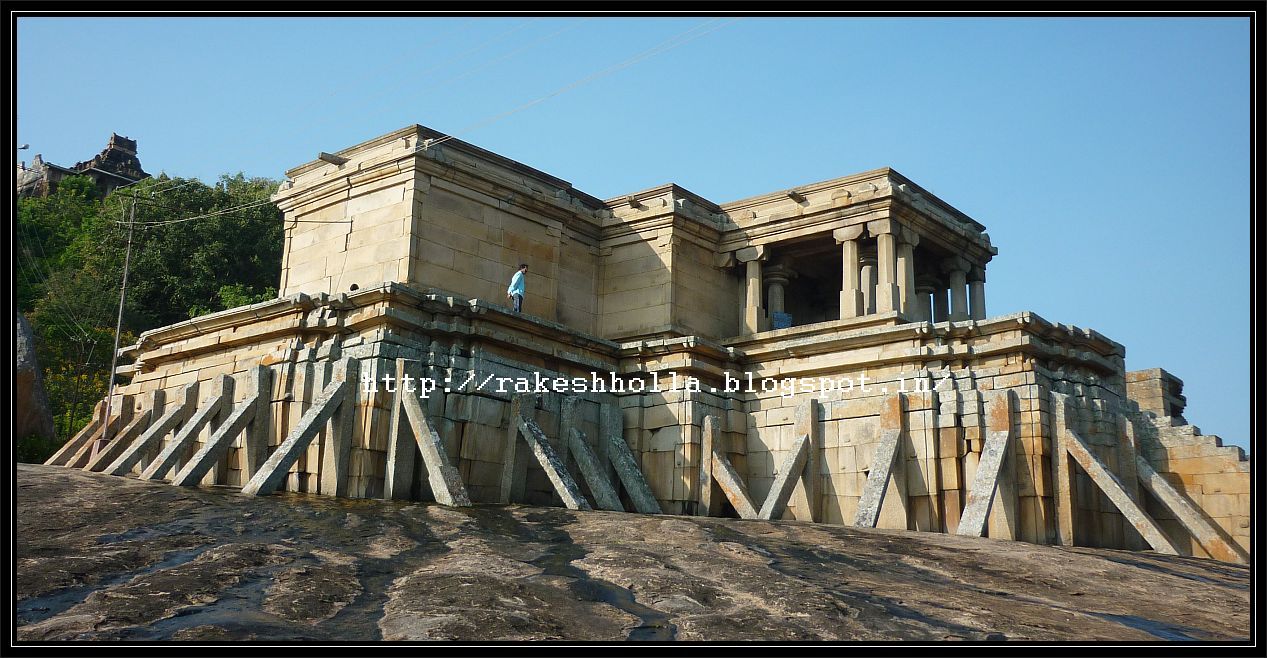
The steps leading to the Odegal Basti contains Adinatha, Neminatha and Shanthinatha icons. Odegal Basti is so called because of the stone props against its basement. It is only Trikutachala temple at Shravanbelagola. Built of granite blocks, it’s impressive for the commanding position it occupies. All the pillars in the main hall are circular in shape and the outer walls are very simple. In the three sanctums are beautiful images of Thirthankaras carved in schist. The temple is known as Trikuta Basadi.

 The Tyagada Brahmadeva Pillar (980 AD.) has intricate carvings. Tyagada Kamba (pillar) is a small open pavilion with an upper storey is historically important. In the center of the pavilion is an elaborately carved pillar which is unmatched in artistic beauty. It was probably erected in the late 10th century. It’s believed that minister Chavunaraya distributed gifts to the needy and the deserving from here. Another view is that he renounced from here all his worldly possessions including his life.
The simple scroll designs elegant workmanship and bold lines bring out the best of the Ganga workmanship. The original inscription at the base was erased in about 1200 AD by Heggade Kanna. This Heggade installed the Yaksa image on top of this pillar and got a record engraved at its pedestal. Some 500 years later an upper Mantapa was built in brick and mortar.
The outer Prakara was erected during the time of Mysore Wodeyars at 17th century. The Siddhanta Basti at its southeast corner was built in the 14th century. It is notable for the 2 commemorative columns in the hall than for the image enshrined in the sanctum. These columns were erected in 1398 and 1432 in honor of saint Panditharadhya and Srtamuni respectively. The text of the second memorial was composed by Mangraja a famous Kannada poet.
The Wadeyar MAntapa on the western corner has a column which has a donatives record. One portion of this record tells how mortgaged property of the temple was got redeemed by the initiative of the Mysore king Chamaraja Wodeyar in 1634 AD. The other portion mentions the grants made for the upkeep of this center by King Dodda Krishnaraja Wodeyar in the 16th century.
 Gullekayi Ajji Mantapa – An image of immense legendary interest is found in this Mantapa. Its open ground floor consists of 5 pillars, an inscription and an image the old lady (Gullekayi Ajji). The upper floor enshrines a Yaksha image. The large central pillar was cut out of a boulder in the 12th century. The inscription column was placed against the central pillar 1422 A.D., by Irugappa Dandanayaka. It mentions the gifts made by this general to Gommata.
The Image of GullekayiAjji wears a pleated saree. According to a local legend, Yakshi Padmavathi transformed herself into an old woman to humble the pride of Chavundaraya. The Gullakayajji sculpture is specimen of very fine workmanship. The Akanda Bagilu is a doorway carved out of single rock. The Siddaragunda is a massive-rock on which rows of Jina figures have been carved.

The Statue of Gommatesvara at Sravanabelagola, the tallest free standing stone sculpture in the world has given a unique and international cultural status toKarnataka. Sravanabelagola is the most sacred religious center of the Jainas. It has a hoary antiquity dating back to the third century B.C., when Bhadrabahu along with the Maurya king Chandragupta came and settled down here.
 From then many Karnataka dynasties like the Gabgas of Talakad, the Chalukyas, the Hoysalas, the rulers of Vijayanagara andothers patronized this Jaina sacred place. However it was during the period of Ganga king Rachamalla IV (9th century), the place became famous because his minister Chamunaraya consecrated this image of Gommatesvara on the summit of the hill commanding a picturesque view of the whole area. A large number of Jainatemples were built here at different periods by various dynasties which have made this center an open air museum of Jaina art.
The real attraction of Sharavanabelagola is the colossal image of Bahubali also known as Gommatesvara. Its height is 54 feet and is the tallest stone sculpture in the world. Theimage is nude and stands facing north in an erect yogic posture. It is a monolith carved around 980 A.D. and considered to be a landmark in the annals of world art. His broad shoulders are 26 feet across. He is a symbol of eternal value, absolute renunciation detachment, and a soul set free from material surroundings. The serene expression of the face is remarkable.
 The hair is curly and the ears are long, the shoulders being broad and the arms hang down straight with the thumbs turned outwards. The lower portion adds majesty and grandeur. The entire image stands on a pedestal which is in the form of a lotus. The foot measures nine feet in length; the forefinger is 3 feet 6 inches; third is 4 feet 7 inches; the fourth finger is 2 feet 3 inches.

 The face of Gommatesvara is most artistic and is a commentary on the success of the skill of the sculptor who carved it. The eyes are half open and the eyes balls appear as if real. This also symbolizes the pensive mood of the saint. The total effect is one of majesty, grace and dignity, and expresses his compassion towards the fellow beings and hence is considered as the best in this type.

Gommatesvara has been watching the human beings and their sufferings for the past one thousand years and people are looking at him for guidance for an ethical and religious life. Thus he is inspiring people to follow the path of Dharma. Once in twelve years a special ritual called Mahamastakabhisheka takes place when lakhs of people assemble here to be blessed by the compassionate Gommatesvara.