Wednesday, March 14, 2012

Mirjan Fort -Kumta

It won’t be that ambiguous as I will give some reasons to elaborate on the love for this beautiful historic fort. It was unexpected surprised visit for me. After one nice trip we returned back to Kumata early so we all together decided to visit this place and we turned our vehicle to this magnificent fort. The Mirjan Fort must have witnessed numerous battles, ghastly episodes of violence and the tears and joys of kings and their subjects. Today, this serene historical site reminds tourists of the glories of the past.
The fort is situated on NH17 in an area of over 10 acres, about 11 km from Kumta. It is beautifully set along the Aganashini River, a tributary of the Sharavathi River. The fort is constructed with Laterite stones, which is available in plenty in the area. The fort has broad steps that lead to the interiors of the fort, where the ruins make visitors ponder over the lost historical significance of the place.
There are watch towers all round the fort. There are two wells constructed inside the fort to preserve water, and escape routes were designed for a quick getaway in case of enemy attack. A temple under a tree the idols are believed to have been unearthed during the excavations but it seems to have crumbled.  The fort can be considered to be as one of the elegant strategic monument. We do think that it is a part of our generation’s responsibility to remain such beautiful heritages safe.
History-
Mirjan Fort was in all probability built originally by Queen Chennabhairadevi, who belonged to the Tuluva-Salva clan under the tutelage of Vijaynagar kings. Rani Chennabhairavdevi was also known as the Pepper Queen or Raina da Pimenta. Her reign was in conformity with the doctrine of succession “Aliyasantana “ or Matriarchal , a tradition followed in coastal belt of konkan and Kerala. Her reign was the longest in the history of female domination in the annals of Indian history, from 1552 – 1606. The strong hold of her territory was centered on North and South Kanara districts and south Goa.
After the battle of Talikota in 1565, the Pepper queen was constantly fighting battle for survival. During this period she shifted her base from Mirjan Fort to somewhat safe haven in Basadi an isle in the middle of river Sharavathi. Being a jain she was responsible for construction of many Basadis in and around Barkur and Moodbidri area.
The original builder seems to have been erased by raiding Bahamani sultans. This Fort was conquered by Sharief-ul-mulk the governor of Goa. He seems to have renovated the Fort to symbolize Moghul architecture.

Saturday, March 10, 2012

Chomkund hill - Kakkabe.

Chomkund hill will always be a place I shall visit again and again. This place will make me wonder whether I step into the land of magic or still firmly stand on the ground. With unearthly nature, unreal landscapes, these destinations will take far away from humdrum reality.
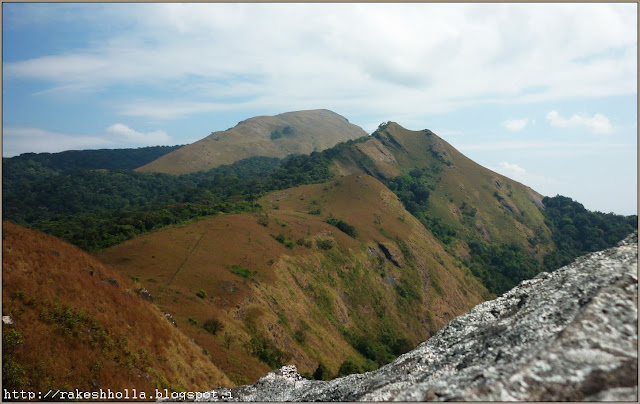
Chomkund hill considered the most beautiful hidden hill ranges in Virajpet, looks like it came straight out of a fairy tale. This hill ranges is famous not only for its magically colorful misty mountains it’s a home for beautiful dramatic landscapes and cliffs, beautiful valleys, milky cascades and coffee plants. Magical and mysterious scenery seems to be much closer to the fantasy world than to reality.
The cheerful mood we started to walk from the village and it was a nice walk, watching birds, smelling of coffee plants all together it was an awesome experience and the views across the journey are just awesome.
This is my third visit to the same place from past 4 years and I can’t hold my emotion while stepping to top. The climb to this hillock is gradient passing through open dry grasslands. However, the scenic beauty at the top of hills more than made up for the efforts.
Panoramic view from the Hillock…

Soon, we reached a beautiful natural view point surrounded by vast jungles, valleys, misty mountains. I would say the view point as one of the loneliest, calmest and beautiful view point on this range. After enjoying the calm atmosphere for about 30 minutes we decided to leave back.
I like to recall my past experiences, some tremendous moments which I could spent in this land few years back . In my first visit when we reached the top soon thick foggy clouds get clouded and covered the whole area on a short time. While on my second visit we made a stay in edge of the another opposite side mountain and the morning till 10am mist and wind was so heavy that the mountain top may be visible for a moment time and the sun rays would played tremendous role on that time to create haven on earth and it was lush green everywhere. But this time the sky was very clean and we able to get some good different snaps.

Wednesday, March 7, 2012

Lakshminarsimha Temple - Bhadravathi

Temple, when we hear this word the scene that comes to our mind usually comprises of the images of God and Goddess, bells and incense sticks, combined with a feeling of calmness. Beyond of all this it’s a symbol of our past architectural attainment and it shows skill of sculptors.
We had a wonderful trip in one fine Sunday; everything went like clockwork as my friend Rajesh Sir expectation. By 11AM we reached the temple which situated in old town of Bhadravathi. This temple built by the Hoysala rulers (Veera Narasimha, the grandson of Vishnuvardhana) in 13th century, it’s highly acclaimed by the each visitor for its architecture, sacredness and serenity.
It is famous for its uniqueness in architecture, which reflects the true spirit of the traditional activities. From its meaningful and distinctive shrine, its magnificent exclusive idols were really fistful to eyes.
A beautiful Garuda Stamba greeted us while we entered the courtyard and the temple is sprawled on either side with perfect proportion. Apart from this, there’s a stone pillar on a small pedestal. The temple has 3 Gopurams (towers) and hence also known as Threekutachala temple. On the outer walls of the temple are carvings of great detail in Hoysala style.
This temple raised on star shaped platform the temple made of soapstone, consists of a Garbhagriha (sanctum) a Navaranga and a Mukhamantapa. It is particularly noteworthy that the niche work and beauty of the five idols in Garbhagriha. The Navaranga pavilion is a large hall with beautifully designed pillars and ceiling and has entrances on the east.
This temple is dedicated to Lord Lakshminarsimha  has some beautiful images inside the temple premises. The Sanctum hall has a large beautifully carved image of Lakshminarsimha (incarnation of Lord Vishnu) exceedingly graceful on the other. Lord Venugopal, Lord Purushottama, Lord Ganesha, Goddess Sharadamba along with Lord Narasimha is one of the finest specimens. It’s decorated with a narrow band of filigree work and could be considered as the best representations of the Hoysala sculptural art.
The outer walls of the temple bear great detailed carvings in Hoysala style. This trip is still one of the most unforgettable trips I have made in Shimoga district.