The saga of temples in Talakad is supported by the rich history of the land of the ancient dynasties of south India, the Gangas (350-1050 AD) were one of the most illustrious who ruled over a greater part of Mysore, then known by the name Gangavadi. Along with the Kadambas, the Gangas rose to power and ruled over the southern part of Karnataka. They continued to rule over Gangavadi till the close of the 10th century. When the Cholas overpowered the Gangas during the 11th century, Talakadu was renamed as Rajapura. In 1117, Vishnuvardhana, one of the greatest rulers of the Hoysala dynasty seized Talakad from the Cholas and assumed the title of Talakadugonda. In commemoration of this achievement, he built the Keerthinarayana temple at Talakad.

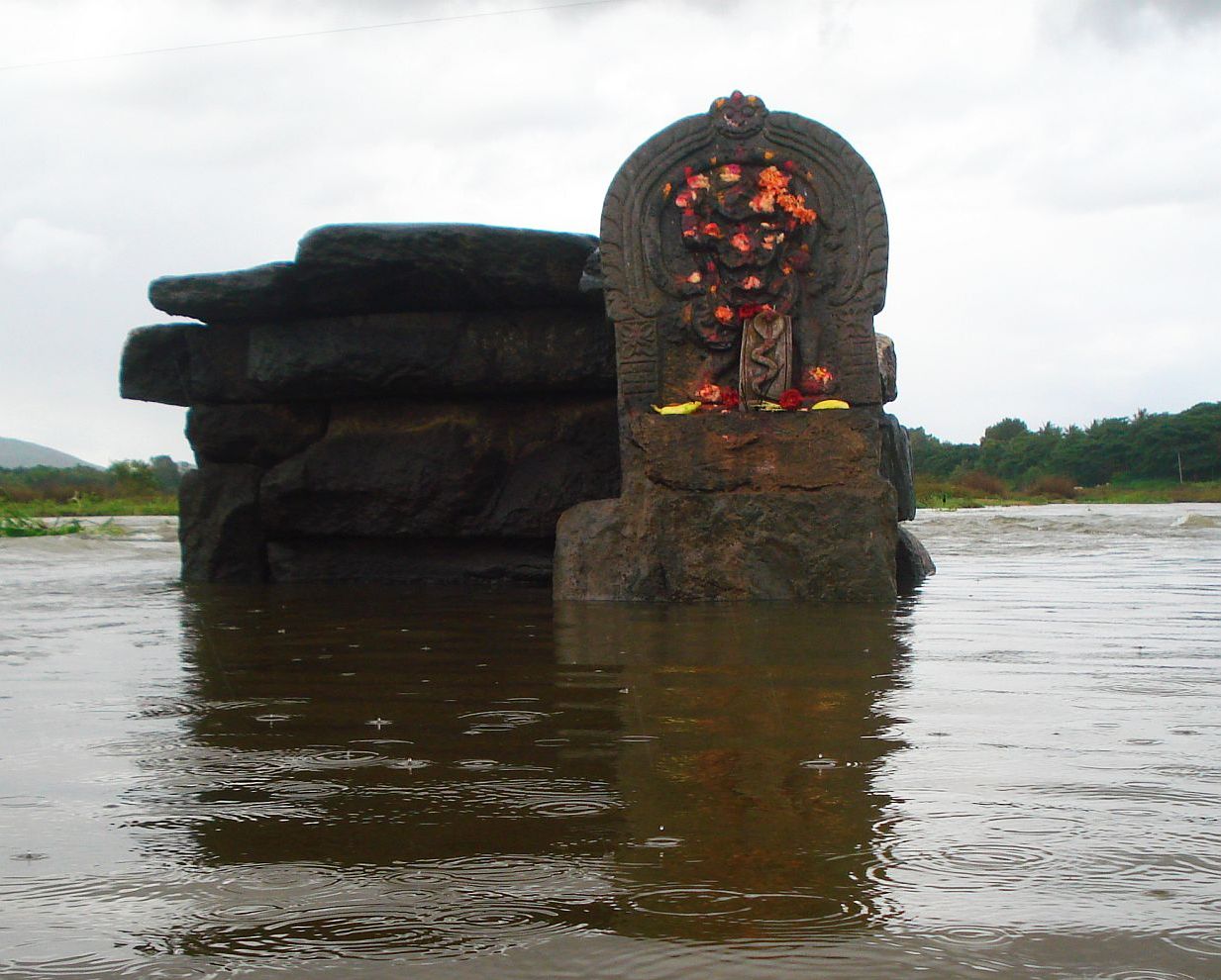
Today, most of the magnificent temples of this ancient town are submerged in sand. The entire stone pillars (square at the base and fitted into a wheel below the abacus) lie scattered throughout the town. Among the temples of Talakad, the Pathaleshwara, Maruleshwara, Arkeshwara, Vaidyanathee-shwara and Mallikarjuna temples form the pancha lingas. In honour of these five Shiva temples, a fair is held once in 12 years called Pancha Linga Darshana. The Pancha Linga Darshana is held on a new moon day during the auspicious month of Karthika.
Keerthi-Narayana Temple (1117 A.D), Talakad
 Besides the Pancha lingas, there are many other magnificent temples in Talakad. The Kapileshwara temple is one such structure that has a Navaranga with pillars, pierced stone windows and ornamented creepers with dancing figures. Another magnificent structure is the Keerthinarayana temple, which is the only temple in Talakad to have been constructed in the Hoysala style of architecture. A greater part of this temple is buried in sand. Other than the sanctum sanctum, there is a Sukanasi and a Navaranga in this temple.
Inside the sanctum sanctum stands an eight-foot-tall statue of Keerthinarayana. Recent excavations in the temple complex have brought to light remains of earlier centuries. Among the findings are an intricately carved Mantapa (with carvings of Ugranarasimha) made of stone, which is about 12 foot tall. A thulasikatte, remnants of a Garuda kamba, 2 stone inscriptions and walls of an unknown structure were also found here.
 The presence of a large mass of sand in Talakad amid lush green vegetation is something that is worth pondering. While geologists say that Talakad is filed with sand carried by the wind from the dry bed of river Cauvery, the locals still prefer to go by the age-old tale of Alamelamma and her curse.
 Localite Rama Nayaka narrates the story rather dramatically. About 400 years ago, Srirangapatana is supposed to have been under the control of the mighty Vijayanagar Empire. Alamelamma was the wife of the king’s representative named Srirangaraya. Every Tuesday and Friday, Sri Ranganaya-kamma borrowed Alame-lamma’s jewels and returned it after the pooja. Meanwhile, Srirangaraya developed a tumour on his back, resembling the hood of a cobra (the disease is called Bennu Phani Roga or Raja Roga in Kannada). Srirangaraya, along with his wife, came to Talakad to worship Vaidyanatheshwara with the hope of being cured of his ailment.
Srirangaraya, however, did not survive for long, and his wife settled down in a small village called Malangi. During this period, the Wodeyars took over Srirangapatna, and started demanding the jewels. When Alamelamma could not bear it no more, she sent a nose ring to Srirangapatana and jumped into a pond in Malangi with the remaining jewels.
 Before she ended her life, Alamelamma is supposed to have uttered three curses, of which one is “Talakadu Marulagi.” When translated to English, it means, “Let Talakadu be covered with sand.” The locals still believe that Alamelamma’s curse is the cause for the large mass of sand in Talakad.