
After Saundatti visit we headed to the grand temple complex of Hooli. Hooli or ancient Hoovalli (Village of flowers) in Belgaum district has great antiquity going back to the se venth century A.D., as evidenced by Badami Chalukya epigraphs.

It was ancient Agrahara and a great educational center where different subjects were taught by famous scholars. The education center was so big that it had many streets where lived separate groups of people including scholars. It was also a renowned Kalamukha center with some famous saints of that faith guiding the socio-religious activities.

The Panchalinga temple is most famous at this place. As the name itself signifies it is the holy abode of five Lingas with five Garbhagrihas. Actually Panchalinga temples are rare in Karnataka. The temple consists five Garbhagrihas, Sukhanasi, a Navaranga and an open Mukhamandapa.

Actually the three Garbhagries are in a row at the back and one Garbhagriha each on the other two sides, thus making a total of five sanctums. This is the uniqueness of this temple. To the right of the central Garbhagriha are Mandapas which have the images of Ganapathi and Vishnu. The five Grabhagries have small Sikharas of the Kadamba Nagara Type, popular in this region.


The outer walls of the Garbhagriha are indented and plain without decorations. But the indented surface itself is pleasing. At the bottom is a plinth of thick horizontal moldings of dentil ornamentation. Above the wall are found two horizontal ornamented bands over which rises the Shikara.

The open Mukhamaqndapa is a highly elegant structure with Kakshasanas inside. Square based octagonal pillars are a great attraction in this temple. The outer pillars are placed on parapet with moldings with low-relief sculptures. This Mandapa is highly conspicuous by its large inclined eave made up of stone slabs, placed in an angle. Over this is a roundish molding with a flat roof. Inside the Navaranga are found Saptamatrika slab and images of Vishnu, Bhirava, Ranganatha, Varaha, Siva etc.

The temple has many inscriptions which throw light on the history of the temple. The Navaranga of the temple has an inscription dated 1181 A.D., belonging to the Kalachuri ruler Ahavamalla, son of Bijjala which records the gift of watershed to the temple. Hence this temple should have been built 1181 A.D. Another inscription is of the time of Chalukya Vikramaditya VI.

Thus this is an elegant Kalyana Chalukya temple in Hooli. This temple stands as evidence to what once must have been a great center for temple architecture and hints at what the other ruined temples would have looked like when they were still standing in their original glory.

Off we go bare footed in the by lanes by village we come across a little structure in complete ruins. A little distance we are greeted by the awesome site many temples scattered around on the hillock across the stream. The many other temples scattered around the village are in dire need of restoration and protection. I heard that most of the temples have their floor dug up for the hunt for treasure so much is lost and stolen.

Other than Panchlingeswara temple Hooli has many other old temples are – Andakeswara temple, Bhavanisankara temple, Kalmeswara temple, Kashi Vishwanatha temple, Madaneswara temple, Suryanarayana temple, Tareswara temple,Sangameswara Ajjanavaru temple, Beerdevar Temple. Even at remotest location on the hills has couple of temples.


Lack of time we left Hooli fort and rest of all beautiful temples and we headed to Sirsangi Kallika temple. After a small journey we reached one of the very popular temples belongs to one community. Outer was renovated so not much to see but inner part of the temple once can amazed by the sculptures and carvings on the stone.

Here Photography is restricted but still we manage to take few beautiful snaps of a couple of statues. After having a grace of Goddess Kali we headed to explore few more beautiful places with new spirit.


 Badami or Vatapi (Sanskrit form) was the capital of the early Chaulukyas.Pulakeshi1, one of the early kings of this dynasty built a strong fort at Badami & made it his capital in the year of 547 A.D., & from that time onwards the later kings of this dynasty built rock-cut & structural temples here for about three hundred years .
 Me& my cousins decided to visit Badami museum & fort. Last 2 times when I visited I had missed this place.First we visited the Museum but as luck goes it was closed, so we decided to finish Fort Mountain, we started to climb in a very beautiful path which was surrounded by red mountains.
 After few minute of walk one side of our way after few steps path just ended between 2 big rocks, squeezing through that narrow path, after a small adventure we were able to reach next part of that rock.


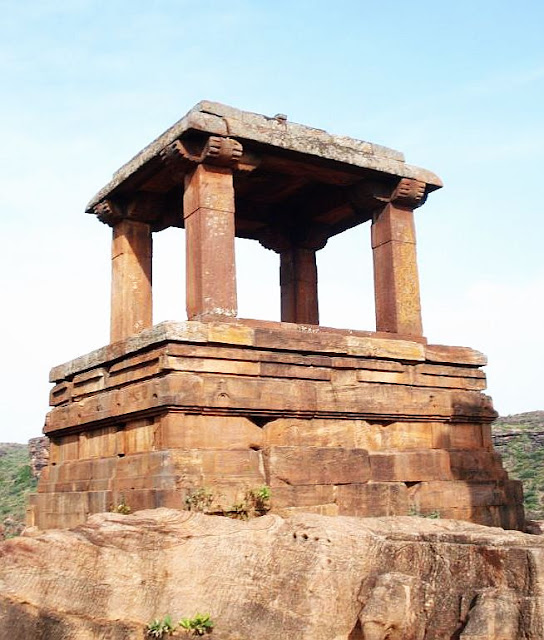 After spending some time in this place we returned back & joined our old pathway. Once again after few minutes’ walk we took one more left deviation which ended near a ruined single temple. The location of this temple was enchanting as it is built on a spur of the rugged hills which overlooked the town of Badami.
 Next we entered another part of the fort, we were little scared because one big group of monkeys were sitting in our path we put all cameras, bottles inside our bags & picked few sticks and started to walk, sensing that we were not disturbing them or harm them they were enjoying their afternoon nap.
 After crossing monkey’s terrain we reached another side end of the fort. There we could get the clear view of one of the oldest & beautiful temple Malegitti Shivalaya (Early 7th century) in Badami.
 Finally we reached top of the hill. There we could see many old ruined houses & temples. One beautiful ruined temple was on edge of the peak. We almost burned because of extreme heat so planned to spend our rest of targeted time in this temple. This temple consists of 2 parts namely Garbagriha & Mukhamantapa.
 The basement consists of molding one of which is thicker & has Ganas carved on it. The wall of the temple consists of plasters at regular intervals. Inside the Garbagriha was empty. The tower over the Garbagriha is a typical Dravidian Sikhara & by its small size looks elegant.
 We all climbed the top (Sikhara) of the temple sort of escapade .Sitting atop of the temple & watching an amazing beauty of the valley, the scenic view of in front Big lake & Cave mountain was mesmerizing we almost traveled back in time to Chalukyan era .................


